

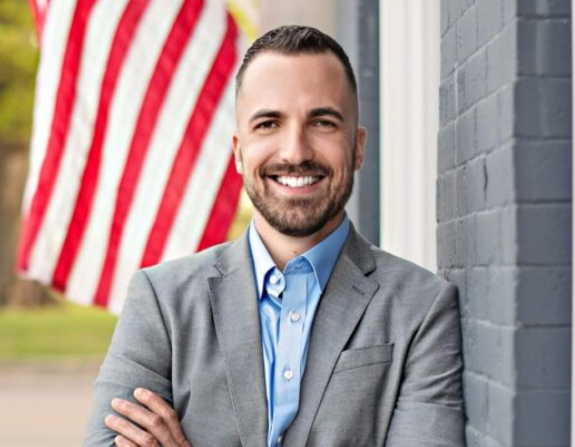
Greetings Friends of the 155th District!
This week the legislature is spending time back in our districts rather than in Jefferson City, giving us the opportunity to meet with and represent the people of the 155th District closer to home. If you would like to meet with me while I’m in the district, please feel free to call my office and we can arrange a convenient time and place to visit. Even though the legislature is not meeting in Jefferson City this week, the work of serving our constituents continues. Please don’t hesitate to reach out—what can I help you with?
Last week in Jefferson City, I had the pleasure of meeting with Amanda and Johnathan Tudor, Jeff Hawkins, Director of the Stone County Ambulance District, and Darryl Coontz, Chief of the Taney County Ambulance District. They were in the Capitol for the Missouri Ambulance Association’s Advocacy Day, and I appreciated the opportunity to visit with them and hear about the important work they are doing to serve our communities.
I also enjoyed meeting with Mikell Smith and six of her students—Natalie, Jonas, Samuel, Julia, Lucy, Lydia, and Newell Hughes. Mikell is their homeschool teacher, and they were visiting the Capitol for Youth at the Capitol Advocacy Day. It is always a pleasure to meet with students who take the time to come to Jefferson City and learn more about the legislative process. If your school or group would like to visit the Capitol and meet with me, please contact my office and we would be happy to arrange a time.
Looking ahead, I want to provide an update on several pieces of legislation I am sponsoring or supporting that are moving through the legislative process this session.
Senate Hearing – What does this mean?
When a bill reaches the Senate for a hearing, it means the legislation has already passed the Missouri House and is beginning the process on the Senate side. The bill will be heard by a Senate committee, and if the committee votes to pass it during an executive session, the bill will move to the Senate floor for debate. If it passes the Senate without changes, it will then be Truly Agreed To and Finally Passed, which is the final legislative step before it can become law.
HB 1644 – Creates new provisions relating to joint employers.
Third Read and Passed the House – What does this mean?
When a bill reaches “Third Read and Passed,” it means the legislation has been debated on the House floor and approved by a vote of House members. These bills are now on their way to the Senate to begin the committee hearing process.
- HCS HBs 1664, 1610, 1645 & 2182 – Modifies provisions relating to statutes of limitation.
- HCS HBs 1826, 2560, 2349 & 2194 – Modifies provisions relating to epinephrine delivery systems.
Rules Hearing – What does this mean?
After a bill passes out of its policy committee, it must go through the House Rules Committee. This step determines whether the bill will be placed on the House calendar for floor debate. Passing through Rules means the bill is one step closer to being debated by the full House.
- HB 1855 – My Alpha-Gal bill, which creates provisions relating to disease surveillance conducted by the Department of Health and Senior Services.
- HB 1641 – Modifies provisions relating to the Joint Committee on Administrative Rules.
- HCS HBs 1717 & 1643 – Modifies provisions relating to alternative therapies and treatments, including psilocybin.
Waiting for a Rules Hearing – What does this mean?
These bills have already passed out of their policy committees and are awaiting a hearing before the Rules Committee. Once they receive a Rules hearing and approval, they will move to the House floor for debate.
- HB 1647 – Establishes provisions relating to duplicative recovery of damages based on insurer reimbursements.
- HCS HBs 2817 & 2961 – Creates provisions relating to ibogaine treatment.
I will continue to keep you updated as these bills move through the legislative process and appreciate hearing from constituents about issues that matter most to them.
Legislative Session Reaches Midpoint as House Prepares for Busy Second Half
The Missouri General Assembly has reached the halfway point of the 2026 legislative session. After several weeks of committee hearings, floor debate, and legislative work in Jefferson City, members of the House are now returning to their districts for the traditional spring break. This brief pause allows lawmakers to reconnect with constituents before returning to the Capitol to begin the second half of session.
While the break offers a short reset, the pace of the legislative process will accelerate significantly once lawmakers return. The final weeks of session are typically when legislation moves most quickly, as bills must clear both chambers and complete the legislative process before adjournment in May.
So far this year, the House has made strong progress advancing legislation. A total of 100 bills have passed the House and been sent to the Senate for further consideration. In addition, the House has already truly agreed to and finally passed three measures that have been sent to the governor’s desk to be signed into law.
One of those measures is HCS HB 2014, the supplemental budget bill for state operations. The legislation provides approximately $3.1 billion to support state agencies and programs through the remainder of the fiscal year ending June 30, 2026. The bill includes funding for disaster recovery efforts following the 2025 storms, transportation projects across Missouri, and support for rural healthcare programs. It also adjusts several previously approved appropriations to ensure state spending reflects current needs.
The House has also made progress on Missouri’s operating budget for the upcoming fiscal year. After more than nine hours of deliberation late Wednesday night, the House Budget Committee completed markup of the 12 appropriations bills that make up the state’s operating budget. The committee approved a spending plan totaling approximately $50.6 billion for the fiscal year beginning July 1, compared to the $52.1 billion budget proposed by Governor Mike Kehoe.
House budget leaders moved the spending bills forward before the spring break with the goal of bringing the full budget to the House floor for debate and passage when lawmakers return to Jefferson City on March 23. Once the House completes its work on the budget, the legislation will move to the Senate for further review.
As the legislature enters the second half of the session, the coming weeks will determine which proposals ultimately reach the governor’s desk before lawmakers adjourn in May.
Legislation Passed Ensures Pregnancy Will Not Delay Divorce Proceedings
The Missouri General Assembly has given final approval to HCS HBs 1908 and 2337, legislation clarifying that pregnancy cannot prevent a court from issuing a judgment of dissolution of marriage or legal separation.
Under current practice, individuals in Missouri may file for divorce while a party is pregnant. However, in many cases courts have interpreted existing law as preventing a divorce from being finalized until after a child is born so that custody matters can be addressed. This interpretation has created inconsistent outcomes across the state and has sometimes delayed divorce proceedings for months.
The legislation clarifies that pregnancy alone cannot be used as a reason to delay or deny a final judgment of dissolution or legal separation. Courts will still be able to address issues involving custody, support, and other matters related to the child once the child is born, but the marital status of the parties will no longer have to remain unresolved during that time.
Supporters note that the clarification is especially important in cases involving domestic violence, where delays in finalizing a divorce can prolong legal ties between individuals seeking separation. By ensuring courts have the authority to finalize divorces regardless of pregnancy status, the legislation may help individuals leave unsafe situations more quickly.
The measure now heads to the governor’s desk for final consideration.
General Assembly Approves Criminal Justice Reforms
Lawmakers have also given final approval to SB 888, legislation that updates several areas of Missouri’s criminal and juvenile justice systems.
The bill strengthens procedures related to juvenile offenses by requiring fingerprints to be submitted to the state’s central repository when individuals under the age of eighteen are taken into custody for certain felony offenses. While these records remain closed to the public, the change helps ensure law enforcement agencies maintain accurate records when addressing serious crimes involving juveniles.
The legislation also modifies the process used when courts consider whether a juvenile should be certified to stand trial as an adult. Certification hearings are more specifically tied to serious offenses such as Class A or B felonies, felony sexual offenses, or repeated felony conduct within a short period of time.
Additional provisions allow counties to work together to establish and operate juvenile detention facilities, subject to rules established by the Missouri Supreme Court. Participating counties may approve a local sales tax of up to one percent to support operations.
The bill also updates sentencing policies by establishing revised parole eligibility guidelines based on felony classification and expanding the definition of “dangerous felony” to include additional crimes, including certain human trafficking offenses.
House Sends Anti-Trafficking and Child Protection Legislation to Governor
The General Assembly has also given final approval to comprehensive legislation strengthening Missouri’s laws related to human trafficking, child exploitation, and sexual offenses.
The bill updates state law by replacing the term “child pornography” with “child sexual abuse material,” reflecting terminology commonly used by law enforcement and advocacy organizations. It also expands the definition to include anatomically correct dolls, mannequins, or robots intended to resemble minors for sexual exploitation.
The legislation establishes the offense of grooming of a minor, making it a felony for an adult to engage in a pattern of conduct intended to prepare or manipulate a minor for sexual activity or exploitation. Individuals convicted under this provision must serve at least five years before becoming eligible for probation or parole.
Additional provisions strengthen penalties for child trafficking offenses, expand opportunities for victims to pursue civil damages, and require expanded human trafficking awareness training for professionals such as emergency medical technicians, prosecutors, social workers, juvenile officers, peace officers, and lodging employees.
The legislation also creates the Statewide Council Against Adult Trafficking and the Commercial Sexual Exploitation of Children within the Office of the Attorney General to coordinate prevention efforts, support victims, and improve enforcement statewide.
House Advances Proposal to Phase Out Missouri’s Individual Income Tax
The Missouri House has approved HJR 173 and 174, a proposed constitutional amendment that would place before voters a plan to gradually reduce and eventually eliminate the state’s individual income tax.
Under the proposal, the income tax rate would decrease incrementally whenever state revenues exceed a set threshold above 2025 levels, adjusted annually for inflation. Multiple reductions could occur in a single year if revenue growth allows. Once the rate falls below 1.4 percent, the tax would be fully eliminated.
Because the measure would amend the Missouri Constitution, it must be approved by voters before taking effect.
Department of Revenue Warns of Text Message Scam
The Missouri Department of Revenue is warning residents about a surge of phishing text message scams. The messages often claim to be from the Department of Revenue or the Department of Motor Vehicles and may threaten penalties for unpaid traffic violations, toll charges, or other fines.
Officials say the messages are scams and are not sent by the Department of Revenue. The department does not request payments or personal information through text messages.
Residents who receive suspicious messages are encouraged not to click on any links, provide personal information, or respond. Instead, they should delete the message and help raise awareness by informing others about the scam.
If you ever have, any questions or concerns feel free to call me at 573-751-2042 or email me at Matthew.Overcast@house.mo.gov. Our office is always here for you.